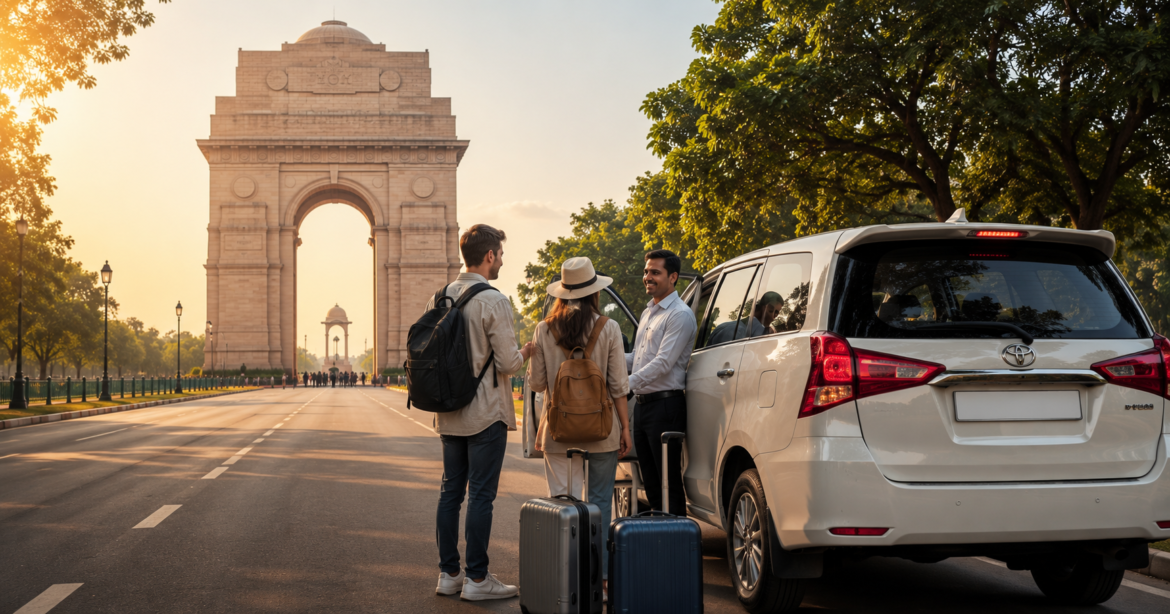
Golden Triangle Tour from Delhi
For many international visitors, Delhi is where an Indian adventure begins. The capital has excellent international air connections and sits at the natural starting point of India’s most famous tourist circuit: Delhi, Agra and Jaipur.
A Golden Triangle Tour from Delhi takes travellers from the historic monuments and lively neighbourhoods of the capital to the Taj Mahal in Agra and onward to Rajasthan’s royal city of Jaipur. Depending on your available time, the journey can be completed in three or four days, although five to seven days provides a much more relaxed experience.
For first-time visitors who want to understand the route before choosing an itinerary, our Golden Triangle travel guide provides a broader introduction to the destinations, planning considerations and experiences along the way.
Quick Answer: How Does a Golden Triangle Tour from Delhi Work?
The classic route begins in Delhi and follows this sequence:
Delhi → Agra → Jaipur → Delhi
Delhi to Agra is approximately 230 kilometres by road, while Agra to Jaipur is roughly 240 kilometres. The final journey from Jaipur back to Delhi is approximately 280 kilometres.
Most travellers use a private air-conditioned car with a driver because it provides door-to-door transfers and flexibility for sightseeing stops. Trains can also be used for selected sectors.
A typical trip includes:
- Old and New Delhi sightseeing
- Taj Mahal
- Agra Fort
- Fatehpur Sikri
- Amber Fort
- City Palace
- Hawa Mahal
- Jantar Mantar
- Local markets and cultural experiences
The result is a compact journey through Mughal, Rajput and modern Indian history.
Table of Contents
- Why Start the Golden Triangle in Delhi?
- Delhi–Agra–Jaipur Route Explained
- How Many Days Do You Need?
- Day 1 – Explore Delhi
- Day 2 – Delhi to Agra
- Day 3 – Agra to Jaipur
- Jaipur Sightseeing
- Return to Delhi
- Best Transport Options
- Best Time to Travel
- Cost and Planning Tips
- FAQs
Why Start the Golden Triangle Tour in Delhi?
Delhi is the most practical starting point for overseas travellers.
Indira Gandhi International Airport receives direct and connecting flights from major cities across the USA, UK, Australia, Canada, Europe, the Middle East and Asia.
Starting here also creates a logical circular itinerary rather than repeatedly travelling over the same roads.
Delhi itself deserves time rather than being treated simply as an airport stop. The capital contains monuments representing several periods of Indian history, alongside busy markets, modern neighbourhoods and excellent restaurants.
If your schedule allows, spend at least one full day exploring the city. Our Delhi local tour package covers many of the capital’s major attractions before the journey continues towards Agra.
Understanding the Delhi–Agra–Jaipur Route
One reason the Golden Triangle works particularly well for first-time visitors is the relatively manageable distance between its three cities.
| Route | Approx. Distance | Typical Road Time |
|---|---|---|
| Delhi → Agra | 230 km | 3–4 hours |
| Agra → Jaipur | 240 km | 4–5 hours |
| Jaipur → Delhi | 280 km | 5–6 hours |
Journey times can vary with traffic, weather and sightseeing stops, so itineraries should never be planned too tightly.
For a more detailed breakdown of each sector, see our Delhi Agra Jaipur distance and travel time guide.
How Many Days Are Best?
There is no single ideal duration for every traveller.
3 Days – Fast-Paced
A three-day itinerary is possible if your schedule is extremely limited.
You will see the major highlights, but expect early starts and relatively long sightseeing days.
Our 3-day Golden Triangle itinerary is designed specifically for travellers working with a short schedule.
4 Days – Comfortable Introduction
Four days gives you more breathing room.
A typical plan could be:
Day 1: Delhi sightseeing
Day 2: Delhi → Agra
Day 3: Agra → Jaipur
Day 4: Jaipur → Delhi
Our Delhi Agra Jaipur 4-day tour is a useful option if you want to cover the essentials without extending the trip for a full week.
5 Days – Recommended for Most Travellers
Five days allows more sightseeing time in Delhi and Jaipur and reduces the need to rush between attractions.
Travellers can also include experiences such as:
- Taj Mahal at sunrise
- Fatehpur Sikri
- Jaipur markets
- Local cuisine
- Heritage walks
- Evening cultural experiences
You can compare the route with our Delhi Agra Jaipur 5-day itinerary .
6–7 Days – Best for a Relaxed Holiday
A week gives you time to enjoy the destinations rather than simply photograph the major landmarks and move on.
This duration works particularly well for:
- Families
- Couples
- Senior travellers
- Photography enthusiasts
- First-time India visitors
- Travellers staying in premium or heritage hotels
Day 1 – Discover Delhi
Begin your journey with the contrasts of Old and New Delhi.
Old Delhi
Start around the historic heart of the city.
Popular stops include:
- Jama Masjid
- Chandni Chowk
- Red Fort area
- Raj Ghat
A rickshaw ride through Chandni Chowk provides a fascinating introduction to the narrow lanes, spice shops, food stalls and markets of Old Delhi.
New Delhi
Later, explore some of the capital’s grander monuments and boulevards.
Highlights may include:
- India Gate
- Humayun’s Tomb
- Qutub Minar
- Parliament district
- Lotus Temple
Avoid packing too many attractions into the first day, especially if you have arrived after a long international flight.
Overnight: Delhi
Day 2 – Delhi to Agra and the Taj Mahal
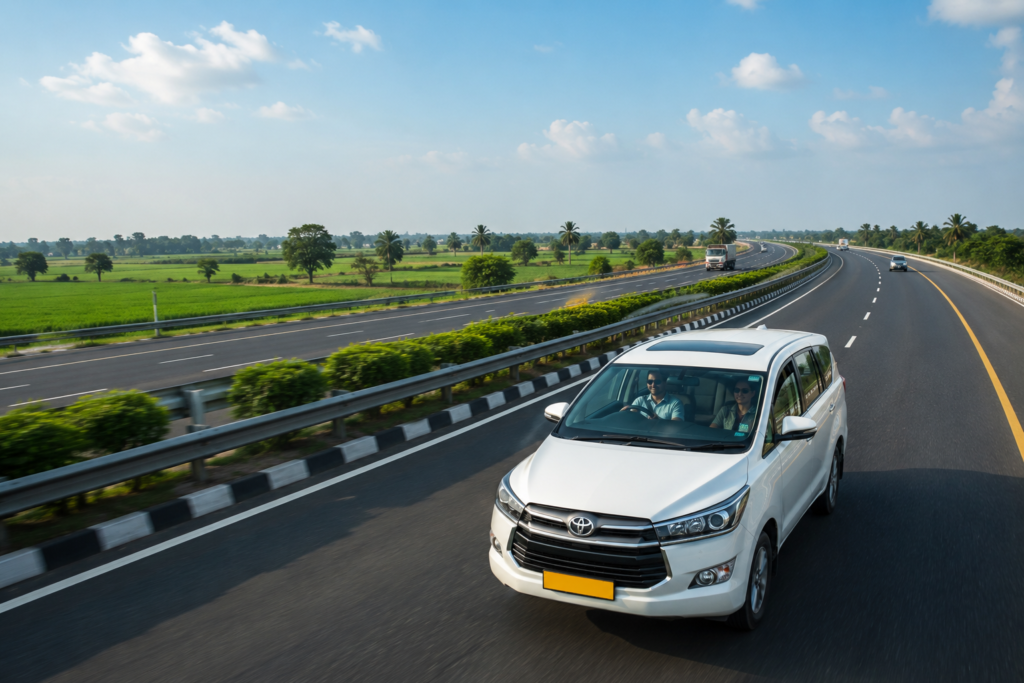
After breakfast, leave Delhi for Agra.
The Yamuna Expressway has made this one of the easiest long-distance road journeys on the Golden Triangle.
Travellers who only want to experience Agra without continuing to Jaipur can instead consider a dedicated Delhi to Agra tour .
After reaching Agra, check into your hotel and begin sightseeing.
Agra Fort
Start with Agra Fort, a UNESCO World Heritage Site that served as an important residence of Mughal emperors.
The massive red sandstone walls conceal:
- Royal courtyards
- Audience halls
- Marble palaces
- Mosques
- Views towards the Taj Mahal
Mehtab Bagh at Sunset
Later in the afternoon, cross the Yamuna to Mehtab Bagh.
The riverside garden provides a beautiful view of the Taj Mahal, particularly as the light softens towards sunset.
It also gives you a completely different perspective from the famous symmetrical view inside the Taj Mahal complex.
Should You Visit the Taj Mahal at Sunset or Sunrise?
If your itinerary includes an overnight stay in Agra, consider saving the main Taj Mahal visit for the following morning.
Sunrise often offers softer light, cooler temperatures and a memorable atmosphere.
Our Taj Mahal sunrise vs sunset guide explains the advantages of both options so you can decide which suits your itinerary.
Overnight: Agra
The next stage of the journey begins with the Taj Mahal at sunrise before travelling through Fatehpur Sikri towards Jaipur.
Day 3 – Taj Mahal at Sunrise and Drive to Jaipur
Wake before sunrise for the most anticipated experience of the journey: seeing the Taj Mahal in the gentle morning light.
The monument was commissioned by Mughal emperor Shah Jahan in memory of his wife Mumtaz Mahal and is today recognised as a UNESCO World Heritage Site. Its white marble exterior changes subtly with the light, which is one reason early morning remains a favourite time for photographers.
Arriving early can also mean cooler temperatures and a calmer atmosphere than later in the day.
Before deciding exactly when to arrive, check our Taj Mahal opening hours guide. Travellers who want the entire morning organised can also consider a sunrise Taj Mahal tour with local sightseeing arrangements.
Practical Tips for Visiting the Taj Mahal
Allow roughly two to three hours if you want to explore the complex without rushing.
Keep in mind:
- Security screening takes place before entry.
- Large bags and certain restricted items cannot be carried inside.
- Comfortable footwear is recommended.
- Carry your passport or appropriate identification if required for your ticket.
- Photography rules differ in certain areas.
- The Taj Mahal is normally closed to general visitors on Fridays.
If photography is important to you, our Taj Mahal photography tips explain useful viewpoints, lighting conditions and practical considerations.
After your visit, return to the hotel for breakfast and check out.
Agra to Jaipur via Fatehpur Sikri
The drive from Agra to Jaipur is not simply a transfer day. One of the most historically significant stops on the Golden Triangle lies along this route.
Fatehpur Sikri
Approximately 40 kilometres from Agra, Fatehpur Sikri was developed by Mughal emperor Akbar in the 16th century.
The historic complex contains an impressive collection of palaces, courtyards and religious buildings.
Important sights include:
- Buland Darwaza
- Jama Masjid
- Tomb of Salim Chishti
- Diwan-i-Khas
- Panch Mahal
- Royal courtyards
Allow around one-and-a-half to two hours for a meaningful visit rather than treating it as a quick photo stop.
Afterwards, continue towards Jaipur through the landscapes of Rajasthan.
Depending on your pace and departure time, you will generally reach Jaipur by late afternoon or evening.
Check into your hotel and enjoy a relaxed evening.
Overnight: Jaipur
Day 4 – Jaipur’s Forts, Palaces and Pink City
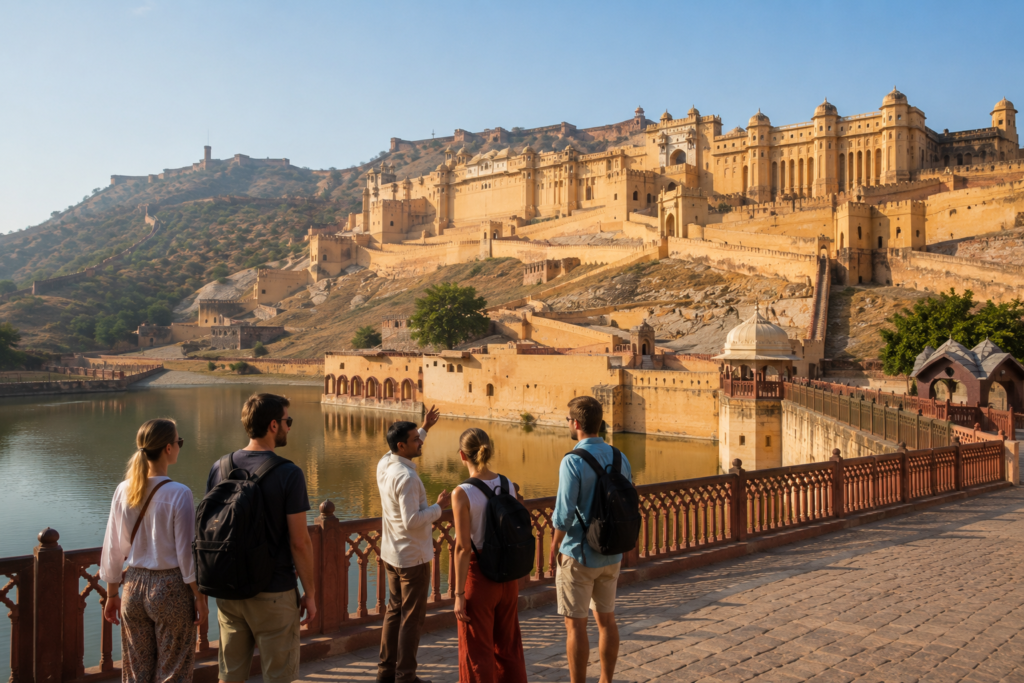
Jaipur provides a dramatic change of atmosphere after Delhi and Agra.
Known as the Pink City, Rajasthan’s capital combines grand Rajput architecture, colourful bazaars and royal traditions.
If Jaipur is one of the highlights of your trip, our Jaipur sightseeing tour provides a more detailed way to explore the city’s major attractions.
Amber Fort
Begin early at Amber Fort, located on the hills outside central Jaipur.
The impressive complex overlooks Maota Lake and contains elaborate gateways, courtyards and royal apartments.
Highlights include:
- Ganesh Pol
- Sheesh Mahal
- Diwan-i-Aam
- Diwan-i-Khas
- Royal courtyards
- Panoramic viewpoints
Starting early is particularly worthwhile during warmer months because much of the visit involves walking.
Jal Mahal
On the return towards Jaipur, stop beside Man Sagar Lake for views of Jal Mahal.
The palace appears to float on the water and is one of the city’s most recognisable photography locations.
It is primarily a viewpoint stop rather than a conventional palace visit.
City Palace
Continue to the City Palace in central Jaipur.
The complex combines Rajput and Mughal architectural influences and includes courtyards, gateways, museums and royal collections.
Parts of the palace continue to be associated with Jaipur’s royal family.
Jantar Mantar
Next door is Jantar Mantar, an extraordinary collection of astronomical instruments constructed during the reign of Sawai Jai Singh II.
A knowledgeable guide can make this site considerably more interesting by explaining how the enormous instruments were designed to observe astronomical movements and measure time.
Hawa Mahal
Finish the main sightseeing programme around Hawa Mahal.
The Palace of Winds is famous for its distinctive multi-windowed façade overlooking Jaipur’s old city.
Rather than simply stopping outside for a photograph, spend some time exploring the surrounding streets and markets. This is where Jaipur’s everyday character becomes more visible.
For travellers who want a dedicated programme covering the city, our Jaipur city tour package can be incorporated into a longer India itinerary.
Overnight: Jaipur
Day 5 – Jaipur to Delhi
After breakfast, begin your return journey to Delhi.
The distance is roughly 280 kilometres, but road conditions and traffic approaching the capital can affect journey times. Avoid scheduling an international flight too close to your expected arrival time.
If possible, stay overnight in Delhi before a long-haul flight. This provides a useful buffer against unexpected road delays.
Travellers with additional days do not necessarily need to return immediately. Jaipur can also become the starting point for a longer journey into Rajasthan.
Private Car or Train: Which Is Better?
Both can work, but they offer very different experiences.
| Factor | Private Car | Train |
|---|---|---|
| Door-to-door travel | Excellent | Limited |
| Schedule flexibility | Excellent | Fixed |
| Luggage convenience | Excellent | Moderate |
| Sightseeing stops | Easy | Difficult |
| Fatehpur Sikri en route | Convenient | Requires planning |
| Local transfers | Included if arranged | Separate |
| Experience | Private and flexible | More local |
Why Many International Travellers Choose a Private Car
The greatest advantage is flexibility.
Your driver can collect you directly from the hotel, stop when necessary and take you directly to your next accommodation.
This becomes particularly valuable between Agra and Jaipur because Fatehpur Sikri can be incorporated naturally into the journey.
Families, senior travellers and visitors carrying substantial luggage often find this arrangement more comfortable.
When Does the Train Make Sense?
Train travel can be worthwhile when you want a faster connection on a specific sector or want to experience India’s railway system.
For example, travellers interested primarily in Delhi and Agra can compare road travel with a same-day Taj Mahal tour by train.
For the complete Delhi–Agra–Jaipur circuit, however, a private vehicle generally provides greater itinerary flexibility.
Best Time for a Golden Triangle Tour from Delhi
The circuit operates throughout the year, but weather conditions can significantly affect your experience.
October to March
This is generally the most comfortable period for sightseeing.
Expect cooler conditions, particularly during mornings and evenings.
December and January can bring fog to Delhi and Agra. This occasionally affects road, rail and air schedules and can also reduce early-morning visibility.
April to June
Summer can be extremely hot, particularly during the afternoon.
If travelling during this period:
- Start sightseeing early.
- Carry drinking water.
- Use sun protection.
- Schedule indoor attractions during the hottest hours.
- Choose an air-conditioned vehicle.
The advantage is that some attractions may feel less crowded than during peak winter.
July to September
The monsoon brings humidity and periodic rain but also greener landscapes.
Rainfall is not necessarily continuous throughout the day, so the circuit remains possible with a flexible itinerary.
For a detailed month-by-month comparison, read our best time for the Golden Triangle India guide before selecting your travel dates.
How Much Does the Tour Cost?
There is no single fixed price because the total depends on:
- Number of travellers
- Number of days
- Hotel category
- Vehicle type
- Guide services
- Monument entrance fees
- Meals
- Airport transfers
- Travel season
- Optional experiences
A couple staying in comfortable mid-range hotels will naturally have a different budget from a family requiring multiple rooms or travellers choosing five-star heritage properties.
Rather than judging packages only by the headline price, compare exactly what is included.
Our Golden Triangle tour cost guide provides a more detailed explanation of the expenses involved.
Choosing Hotels in Delhi, Agra and Jaipur
Hotel location can make a noticeable difference to your experience.
A cheaper hotel far outside the main sightseeing areas may save money on the room but add unnecessary driving every morning and evening.
In Delhi, consider your arrival airport, sightseeing plans and onward route.
In Agra, staying overnight is particularly worthwhile if you want to visit the Taj Mahal at sunrise. Our guide to hotels in Agra can help you understand the available accommodation options.
Jaipur offers everything from modern international hotels to atmospheric heritage properties.
Choose according to your preferred balance of comfort, location and local character.
Expert Planning Tips
A few decisions can make the journey considerably smoother:
- Do not make the itinerary too tight. Five days is much more comfortable than trying to squeeze everything into three.
- Stay overnight in Agra. It makes an early Taj Mahal visit considerably easier.
- Start sightseeing early. You’ll often encounter cooler temperatures and fewer crowds.
- Use local guides selectively. Good guides add considerable context at monuments such as the Taj Mahal, Agra Fort, Fatehpur Sikri and Jaipur’s historic sites.
- Keep some flexibility. Traffic, weather and monument queues are part of travelling in India.
- Check monument closures before finalising dates. In particular, plan carefully around the Taj Mahal’s Friday closure.
- Avoid booking a tight international connection after Jaipur. Build a buffer into the final return to Delhi.
Common Mistakes to Avoid
Trying to See Too Much
More attractions do not automatically make a better holiday.
Three meaningful monument visits can be more rewarding than rushing through seven locations simply to complete a checklist.
Treating Agra as Only the Taj Mahal
The Taj Mahal deserves its fame, but Agra Fort and the city’s Mughal heritage add important historical context.
Underestimating Driving Time
Distances may appear manageable on a map, but traffic can change actual journey times.
Always keep some flexibility.
Choosing Hotels Only by Price
Location, cleanliness, recent guest reviews and access to sightseeing areas are often more important than saving a small amount on the nightly rate.
Ignoring the Season
A sightseeing schedule that works perfectly in January may feel exhausting in May.
Adapt your daily programme to the weather rather than following the same itinerary year-round.
Is Starting from Delhi the Best Choice?
For most overseas visitors, yes.
Delhi combines an international gateway with excellent connections to Agra and Jaipur, making it the natural starting and finishing point for the circuit.
It also means the trip develops gradually: first the complexity of India’s capital, then the Mughal heritage of Agra, followed by the royal character of Rajasthan.
That progression is one of the reasons the Golden Triangle remains such a rewarding introduction to North India.
Frequently Asked Questions About Golden Triangle Tours from Delhi
1. What is a Golden Triangle Tour from Delhi?
A Golden Triangle Tour from Delhi is a multi-city journey connecting Delhi, Agra and Jaipur. Most itineraries begin with sightseeing in Delhi, continue to Agra for the Taj Mahal and Agra Fort, travel onwards to Jaipur for its forts and palaces, and finally return to Delhi.
2. How many days are enough for Delhi, Agra and Jaipur?
Four days is possible, but five to seven days provides a much more comfortable experience. Travellers with a full week can spend more time sightseeing, enjoy local markets and cultural experiences, and avoid rushing between cities.
If you’re unsure about the ideal duration, our guide to how many days you need for the Golden Triangle compares different itinerary lengths.
3. How far is Agra from Delhi?
Agra is approximately 230 kilometres from Delhi by road. The journey commonly takes around three to four hours using the Yamuna Expressway, although actual travel time depends on your starting point and traffic conditions.
4. Should I visit Agra or Jaipur first from Delhi?
The classic route is Delhi → Agra → Jaipur → Delhi.
This sequence works particularly well because Agra is easily accessible from Delhi via the Yamuna Expressway, while Fatehpur Sikri can be visited naturally during the onward journey from Agra to Jaipur.
5. Can I complete the Golden Triangle by private car?
Yes. A private air-conditioned car with a driver is one of the most convenient ways to complete the circuit.
It provides door-to-door transportation, flexible departure times and the ability to stop at attractions along the route.
6. Is a Golden Triangle Tour suitable for first-time visitors to India?
Yes. It is particularly popular among first-time visitors because Delhi, Agra and Jaipur offer three very different introductions to Indian history, architecture, cuisine and culture within a relatively compact geographical area.
If this is your first holiday in the country, our first-time India travel tips cover practical topics worth understanding before departure.
7. Can I customise the itinerary?
Yes. A private itinerary can normally be adjusted according to your arrival time, hotel preferences, interests and number of available days.
Popular extensions include Ranthambore National Park, Udaipur, Varanasi, Amritsar and Goa.
Travellers interested in wildlife can explore a Golden Triangle tour with Ranthambore , combining the classic cultural route with a national park experience.
8. What should I pack for the Golden Triangle?
Pack according to the season, but comfortable walking shoes, lightweight clothing, sun protection and modest clothing for religious sites are useful throughout much of the year.
Winter travellers should bring warmer layers for early mornings, particularly in Delhi and Agra.
Our Golden Triangle packing guide provides a more detailed checklist.
Conclusion
A Golden Triangle Tour from Delhi is one of the most practical and rewarding ways to experience North India for the first time.
Starting in the capital gives international travellers convenient access to the route while also providing an opportunity to experience Delhi’s remarkable contrast between historic neighbourhoods and modern India.
From there, the journey moves to Agra, where the Taj Mahal and Agra Fort reveal the grandeur of the Mughal era. Continuing through Fatehpur Sikri towards Jaipur introduces another side of Indian history through Rajasthan’s hill forts, royal palaces, colourful bazaars and distinctive traditions.
The route can be completed quickly, but there is a significant difference between simply seeing the Golden Triangle and genuinely experiencing it.
If your schedule allows, give yourself at least five days. Travellers with six or seven days can slow the pace further, spend more time at individual attractions and add cultural experiences beyond the standard sightseeing programme.
Choosing the right season, keeping realistic driving times and planning your Taj Mahal visit carefully will make the journey considerably more enjoyable.
Plan Your Golden Triangle Journey from Delhi
If Delhi is your arrival point in India, you can build your entire holiday around the Golden Triangle without needing additional domestic flights.
Explore our Golden Triangle tour packages to compare different itineraries through Delhi, Agra and Jaipur.
Travellers who prefer a shorter holiday can consider the 4-day Delhi Agra Jaipur tour, while a 5-day Golden Triangle itinerary provides a more comfortable pace.
If your travel dates, hotel preferences or sightseeing interests do not fit a standard itinerary, the route can also be customised around your arrival and departure schedule.