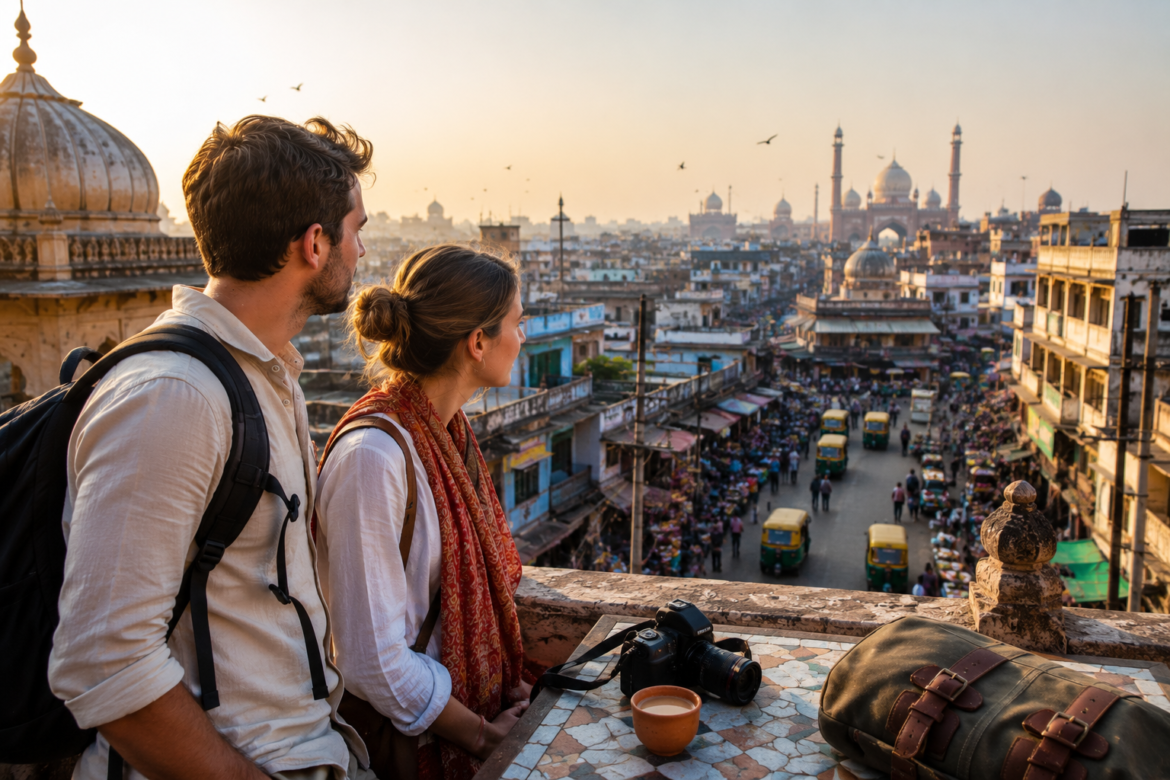
Your first morning in India can feel very different from waking up in New York, Chicago, Los Angeles or almost anywhere else in the United States.
Outside your hotel, you may hear car horns, see a centuries-old monument beside a modern metro line, smell breakfast being prepared at a roadside stall and watch an apparently chaotic intersection somehow continue to move.
Then someone offers you chai.
India isn’t simply a destination with different attractions. The rhythm of everyday life can also be different from what many American visitors are accustomed to.
Some differences require adjustment. Others quickly become favourite memories.
If this will be your first visit, our first-time India travel tips cover practical preparations before you arrive.
But these are ten experiences that may still surprise you once the journey actually begins.
Quick Answer
First-time American visitors to India are often surprised by the intensity of traffic, exceptional hospitality, affordability of many services, variety of Indian food, contrast between ancient and modern life, popularity of digital payments, scale of historic monuments and how different each city can feel.
Understanding these differences before departure can make the first few days much easier and more enjoyable.
1. The Traffic Looks Chaotic — But It Has Its Own Rhythm
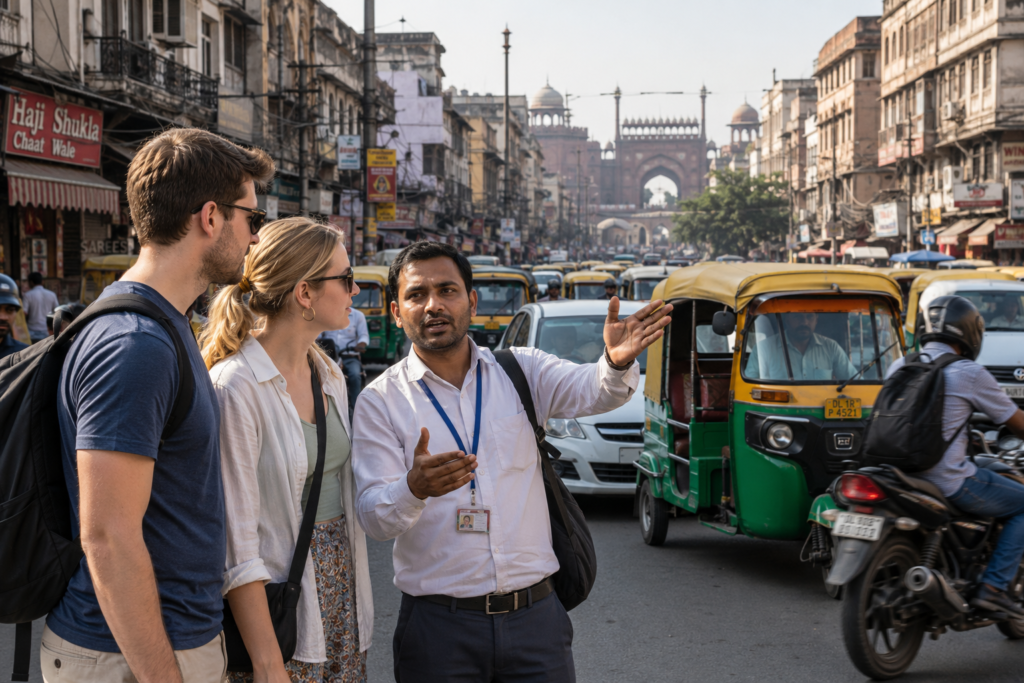
For many Americans, the first drive from an Indian airport is an experience in itself.
Cars, motorcycles, auto-rickshaws, buses and pedestrians may all appear to be negotiating the same road simultaneously.
And then there are the horns.
In much of the United States, honking often signals frustration or danger. In India, horns can also function as communication between road users—a quick way of signalling presence while overtaking or moving through busy traffic.
At first, the roads may look completely unpredictable.
After a few days, however, many visitors begin noticing patterns within the apparent chaos.
What American travellers should do
If you’re visiting major tourist destinations, hiring an experienced driver can make travelling considerably more comfortable.
Avoid planning journeys solely from the distance shown on Google Maps. Traffic conditions can substantially change actual travel times.
This is particularly important on multi-city routes. Our Delhi, Agra and Jaipur distance and travel-time guide gives a more practical overview for travellers planning India’s Golden Triangle.
2. Indian Hospitality Can Feel Remarkably Personal
One of the more pleasant surprises can be how quickly an ordinary interaction becomes personal.
A hotel employee may remember how you take your coffee.
A guide may help you find a particular souvenir after the sightseeing programme has finished.
If you’re invited into an Indian home, there is a reasonable chance you’ll be offered more food than you expected to eat.
The idea that a guest deserves special treatment has deep cultural roots in India, although experiences naturally vary between people and places.
For American visitors accustomed to friendly but relatively structured service interactions, the warmth can sometimes feel surprisingly personal.
A useful cultural tip
Hospitality doesn’t mean you have to accept everything offered.
A polite:
“No, thank you.”
is perfectly acceptable if you’ve had enough food, don’t want to shop or simply need some time to yourself.
3. Indian Food Is Much More Diverse Than the Indian Food You Know in America
If your experience of Indian cuisine comes primarily from restaurants in the United States, prepare for a surprise.
There is no single “Indian food”.
The dishes eaten in Delhi can differ significantly from those found in Rajasthan, Gujarat, Kerala, Punjab or West Bengal.
Even familiar dishes may taste different from their American restaurant versions.
During a Delhi–Agra–Jaipur journey you might encounter:
- Chole bhature
- Parathas
- Dal makhani
- Paneer dishes
- Mughlai cuisine
- Kachori
- Rajasthani thali
- Lassi
- Jalebi
- Masala chai
Vegetarian travellers are often particularly surprised by the range of options.
Vegetarian food isn’t treated as a small alternative section on every menu. In many restaurants, it forms a substantial part—or all—of the menu.
What about spicy food?
“Indian food is spicy” is only partly true.
Indian cuisine uses many spices, but spiced doesn’t necessarily mean extremely hot.
If you’re sensitive to chilli, tell your waiter or guide that you prefer mild food rather than assuming every dish will be too hot.
4. Your Money Can Go Further Than Expected
Many American travellers are surprised by what their travel budget can provide in India.
Depending on the destination and season, services such as:
- Private cars with drivers
- Local guides
- Restaurant meals
- Laundry
- Domestic transport
- Comfortable hotels
may cost considerably less than comparable services in major US cities.
This is one reason travellers who normally plan independent holidays sometimes choose private touring in India.
A private driver, for example, isn’t necessarily limited to ultra-luxury travellers.
On routes such as Delhi–Agra–Jaipur, the convenience can justify the additional expense because the same vehicle can provide hotel-to-hotel transportation and sightseeing flexibility.
If you’re considering this route, our Golden Triangle tour cost guide explains the major expenses involved in planning the journey.
Don’t confuse affordability with “everything should be cheap”
This is important.
Luxury hotels, premium restaurants, domestic flights and exclusive experiences can still be expensive.
The better approach is to think of India as offering a wide range of price points, rather than expecting every product or service to cost very little.
5. The Taj Mahal Feels Different When You’re Actually Standing There
You’ve already seen it.
Probably hundreds of times.
The Taj Mahal appears in films, books, advertisements, school lessons and travel photography around the world.
That familiarity can create an unusual expectation: perhaps seeing it in person won’t feel dramatically different.
Then you walk through the entrance gateway.
The scale, symmetry and changing appearance of the marble are difficult to appreciate from photographs alone.
Many visitors are also surprised by the amount of craftsmanship visible when they get closer to the building.
The experience changes again depending on the time of day.
Early morning can provide softer light and cooler temperatures, while later hours create different colours across the marble.
If the Taj Mahal is one of the main reasons for your India trip, compare the experience in our Taj Mahal sunrise vs sunset guide before deciding when to visit.
Travellers starting in the capital can also incorporate Agra into a broader Golden Triangle tour through Delhi, Agra and Jaipur, rather than treating the Taj Mahal as an isolated day trip.
Halfway Through Your First India Trip…
By this point, something interesting often happens.
The things that felt unfamiliar during the first 24 hours begin to make more sense.
You become better at crossing busy streets.
You know how much cash to carry.
You discover which Indian breakfast you actually like.
The sound of traffic becomes less surprising.
And you begin recognising that India isn’t one experience—it changes considerably from city to city.
The next five surprises are where many first-time American visitors begin discovering that contrast.
6. Ancient and Modern India Exist Side by Side
One of the most fascinating things about travelling through India is how quickly the surroundings can change.
You might spend the morning walking through a centuries-old Mughal monument and later find yourself inside a modern shopping centre, using an app to order dinner or travelling on a contemporary metro system.
In Delhi, historic neighbourhoods such as Old Delhi coexist with business districts, luxury hotels and modern infrastructure.
Agra combines Mughal-era monuments with a busy modern city.
Jaipur’s historic bazaars and royal palaces sit alongside contemporary cafés, hotels and residential neighbourhoods.
For American visitors, this contrast can be more striking than expected because photographs of India often focus on either its historic heritage or its busiest streets. The reality is much more varied.
You may see traditional clothing beside Western fashion, centuries-old markets accepting digital payments and modern cafés operating only a short distance from ancient temples.
That contrast is not an exception to the India experience.
It is part of it.
7. Digital Payments Are Everywhere — But You Still Need Some Cash
Many Americans arrive expecting India to be primarily a cash-based destination.
That assumption can quickly change.
Digital payments have become extremely common, and QR codes can be found at restaurants, shops and many small businesses.
However, international visitors should not assume that every local digital payment method will work with a foreign bank account or credit card.
Major hotels, established restaurants and larger shops commonly accept international cards, while smaller vendors may prefer cash or domestic digital payment systems.
This means the best strategy is usually a combination of:
- International credit or debit card
- A reasonable amount of Indian rupees
- Small denomination notes
- A backup payment method
Avoid carrying excessive cash at once.
ATMs are widely available in major cities, although foreign-card fees and your own bank’s international transaction charges may apply.
For more detailed advice, our India currency and payment guide explains rupees, ATMs, cards and practical payment considerations for overseas visitors.
8. Crowds and Personal Space Can Feel Different
This can be one of the bigger adjustments for visitors arriving from the United States.
India has more than a billion people, and major railway stations, markets, monuments and city centres can become extremely busy.
During peak periods, popular attractions may feel considerably more crowded than many American travellers expect.
The concept of personal space can also feel different in queues, markets and public transportation.
That doesn’t necessarily mean someone is deliberately being rude. Social expectations around space and queuing can simply differ.
How to make busy places easier
A few simple strategies help:
- Visit major monuments early.
- Avoid peak commuting hours where practical.
- Keep valuables secure in crowded areas.
- Carry only what you need during sightseeing.
- Follow your guide through particularly busy markets.
- Allow additional time at railway stations and airports.
The Taj Mahal is a good example.
Visiting early can mean cooler temperatures and a more relaxed experience compared with arriving during the busiest part of the day.
Crowds are also one reason a well-paced itinerary usually works better than trying to squeeze too many attractions into a single day.
9. English Makes Travelling Easier Than Many Americans Expect
Some first-time visitors worry about how they’ll communicate in India.
The reality can be reassuring.
India is extraordinarily multilingual, with Hindi, English and numerous regional languages used across the country.
English is widely used in much of the tourism industry, particularly at:
- Airports
- Major hotels
- Tourist attractions
- Established restaurants
- Tour companies
- Larger shops
- Transport services
Professional guides in popular destinations such as Delhi, Agra and Jaipur regularly work with international visitors.
That doesn’t mean everyone you meet will speak fluent English.
In local markets or smaller communities, communication may require patience, gestures or translation apps.
Learning a few simple Hindi expressions can also make interactions more enjoyable.
For example:
Namaste – Hello / greeting
Dhanyavaad – Thank you
Haan – Yes
Nahi – No
You don’t need to speak Hindi to travel around India’s main tourist destinations, but making even a small effort with local words is often appreciated.
10. The Biggest Surprise: There Is No Single “India Experience”
Perhaps the most important discovery comes after you’ve travelled beyond your first destination.
India changes.
Dramatically.
Delhi doesn’t feel like Agra.
Agra doesn’t feel like Jaipur.
And Rajasthan is completely different from Kerala, Goa, Kashmir or Varanasi.
Even travelling through the classic Golden Triangle demonstrates how much can change within a relatively short distance.
Delhi introduces you to a huge modern capital shaped by many periods of history.
Agra takes you deeper into the Mughal era through the Taj Mahal and Agra Fort.
Jaipur introduces the forts, palaces, markets and traditions of Rajasthan.
Travel farther and the contrasts become even greater.
You’ll find Himalayan landscapes in the north, tropical backwaters in Kerala, beaches in Goa, deserts in Rajasthan and completely different food traditions across the country.
This is why trying to “see India” in one short holiday isn’t realistic.
A better goal is to choose one region and experience it properly.
For many Americans visiting for the first time, Delhi, Agra and Jaipur make a practical introduction because the three cities combine some of India’s best-known landmarks without requiring multiple domestic flights.
What Usually Feels Different After the First Few Days?
The first 24 hours can involve sensory overload.
By day three or four, many things that initially seemed confusing become surprisingly normal.
You start recognising how traffic moves.
You know when to carry cash.
You understand that “Indian food” covers an enormous range of cuisines.
You become more comfortable navigating markets.
And perhaps most importantly, you stop comparing every experience with how things work back home.
That is often when travelling in India becomes much more rewarding.
Instead of asking:
“Why isn’t this like America?”
you begin asking:
“How does this work here?”
That small shift in perspective can completely change the experience.
What Americans Should Know Before Their First India Trip
India rewards preparation, but you don’t need to plan every minute.
Before departure, concentrate on the essentials:
Arrange Your Visa Early
Check India’s current official visa requirements for your nationality well before your flight.
Avoid relying on old travel blogs or social media posts for entry requirements because visa rules can change.
Consider Travel Insurance
International travel insurance can provide protection against eligible medical emergencies, cancellations, baggage problems and other unexpected disruptions.
Read the policy carefully, particularly if your itinerary includes adventure activities or existing medical conditions.
Pack for the Season
India’s weather varies dramatically by location and month.
A January morning in Delhi can feel surprisingly cool, while May afternoons in Agra and Jaipur can be extremely hot.
Pack for your actual destinations rather than treating India as having one climate.
Don’t Overplan Your Itinerary
This is especially important for Americans trying to maximise limited vacation days.
It can be tempting to fit Delhi, Agra, Jaipur, Varanasi, Mumbai and Goa into one short holiday.
You may technically reach all of them, but much of your trip could be spent checking out of hotels, travelling to airports and moving between destinations.
Fewer places with more time in each often creates a better first trip.
A Good First India Itinerary for American Travellers
For a first visit of around one week, the Golden Triangle remains one of the easiest routes to understand and organise.
A comfortable version might look like:
Days 1–2: Delhi
Days 3–4: Agra
Days 5–7: Jaipur and return to Delhi
With additional time, you could extend the journey to Ranthambore for wildlife, Udaipur for Rajasthan’s lakes and palaces or Varanasi for a completely different cultural experience.
The important point is not to add destinations simply because they’re famous.
Choose them because they fit the kind of India experience you want.
Final Thoughts
A first trip from the United States to India can challenge some expectations.
The traffic may be busier.
The flavours may be stronger.
Historic monuments may be larger than photographs suggest.
Hospitality may feel more personal.
And everyday life may operate differently from what you’re used to at home.
But those differences are precisely what make international travel worthwhile.
Arrive prepared, but don’t arrive expecting everything to work exactly as it does in America.
Give yourself enough time to adjust, stay curious and allow room in your itinerary for experiences you didn’t plan.
You may arrive in India expecting the Taj Mahal to be the story you tell everyone when you return home.
Sometimes it is.
But just as often, the lasting memory is something much smaller: morning chai, a conversation with a local guide, an unexpected meal, a market you hadn’t planned to visit or simply watching everyday life unfold from the window of your car.
Planning Your First Trip to India from the USA
If Delhi, Agra and Jaipur are on your list, begin with a comfortable itinerary rather than trying to cover too much of India at once.
Our India tour packages from the USA are designed for travellers planning their journey from the United States, while the Golden Triangle provides a practical starting point for experiencing Delhi, the Taj Mahal and Rajasthan within one trip.
Once you understand the route, you can decide whether to keep your first journey focused on North India or extend it to another region.
Frequently Asked Questions
1. Is India a good destination for American tourists?
Yes. India offers an enormous variety of experiences, including historic monuments, wildlife, food, culture, beaches, mountains and luxury hospitality. First-time visitors generally have a better experience when they choose a manageable region, allow realistic travel times and prepare for cultural differences before arriving.
2. What is the biggest culture shock for Americans visiting India?
This varies by traveller, but busy traffic, crowds, different expectations around personal space and the intensity of major cities can initially feel unfamiliar. Most visitors become more comfortable once they understand the local rhythm and stop expecting everyday situations to work exactly as they do in the United States.
3. Is India expensive for American travellers?
India can offer excellent value for US travellers, particularly for private transportation, local guides, meals and many categories of accommodation. Luxury hotels and premium experiences can still be expensive, so the overall budget depends heavily on your preferred travel style.
4. Can American tourists use credit cards in India?
International cards are commonly accepted at major hotels, established restaurants and larger businesses. Smaller shops and local vendors may prefer cash or domestic digital payment systems, so carrying some Indian rupees alongside your cards is sensible.
5. Is English widely spoken in India?
English is widely used throughout India’s tourism industry, especially at airports, hotels, major attractions and established travel businesses. However, India is highly multilingual, and English fluency varies between regions and individuals.
6. What should Americans avoid doing in India?
Avoid drinking untreated tap water, displaying valuables unnecessarily, ignoring local dress expectations at religious sites and planning extremely tight travel schedules. It is also sensible to avoid assuming that customs and service expectations will be identical to those in the United States.
7. What should I wear on my first trip to India?
Comfortable, breathable and relatively modest clothing works well for most sightseeing. Shoulders and knees should generally be covered when visiting religious sites. Your packing should also reflect the season because winter mornings in North India can be cool while summer temperatures can become extremely hot.
8. Is the Golden Triangle good for a first trip to India?
Yes. Delhi, Agra and Jaipur provide a manageable introduction to India while offering remarkably different experiences. Travellers can experience historic Delhi, the Taj Mahal and Mughal heritage in Agra, followed by Rajasthan’s forts, palaces and markets in Jaipur without relying on multiple domestic flights.
Conclusion
The things that surprise Americans on their first trip to India are not necessarily the things they remember from guidebooks.
Yes, the traffic can be intense. The crowds can take some adjustment. The food may taste different from Indian restaurants back home, and everyday routines may work differently from what you’re accustomed to.
But there are pleasant surprises too.
Private travel can be more accessible than expected. Vegetarian food is remarkably varied. English makes many travel situations easier. Indian hospitality can feel genuinely personal, and historic landmarks that you’ve seen countless times in photographs can still leave a powerful impression when you finally stand in front of them.
Perhaps the most important discovery is that India cannot be understood through a single city, monument or stereotype.
Delhi, Agra and Jaipur alone demonstrate how dramatically architecture, history, food and atmosphere can change within one relatively compact journey.
Arrive prepared, keep your itinerary realistic and remain curious about the differences.
Your first few hours in India may feel unfamiliar.
A few days later, some of those same differences may become the experiences you remember most.